Word for Stones Agains Shoreline to Prevent Erosion
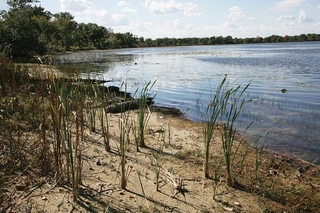
With more shoreline than California, Florida and Hawaii combined, Minnesota is spring to accept areas where shoreland erosion is a trouble. Information technology's obvious that wave-pounded properties lose soil and ultimately their value. What isn't as obvious is that your practices can accelerate or dull erosion. Slow erosion by diverting h2o runoff abroad from hills and bluffs. Use drain pipes or French drains to create a safe route for water that can't be diverted. Exit natural shoreland vegetation and beach rocks undisturbed. The shore edge can be further protected by installing rip-rap (big rocks).
Bluffs and erosion
Shoreland backdrop often gradient toward the h2o. Some hills are gradual, but some are extreme, like bluffs. Erosion is a big problem for bluffs. Increased runoff is especially damaging to high bluffs.
Slumping of bluffs can be caused by:
- Unstable soil caused by surface or basis water reaching the bluff.
- On lakes, waves tin erode supporting soil at the bottom of the bluff.
- Along river bluffs, river currents can erode the supporting soil.
Preventing barefaced erosion
Preclude erosion of higher shoreline bluffs by:
- Retaining wet-absorbing vegetation on the bluff.
- Diverting surface runoff away from the bluff (including rain gutter outlets).
- Reducing runoff rate toward the bluff.
- Minimizing paved areas that increase runoff.
- Limiting ground water flow toward the barefaced.
- Installing septic systems and drainfields away from the bluff.
- Avoiding additional weight on the bluff border, such every bit pools, buildings or storage sheds.
Create safe routes for h2o y'all tin't divert
On belongings with steep slopes or bluffs, reducing the corporeality of water reaching the bluff will help with stabilization. Sometimes, diverting water away from the bluff is impractical. In these cases, create a safe road for the water to travel.
1. Employ a drain pipe that reaches the very lesser of the barefaced.
Use a non-perforated plastic drain pipe that outlets at the very bottom of the bluff. Stone should be placed around the outlet to prevent erosion at the bottom of the bleed.
2. Install a "French drain" to catch surface water.
Surface water and some ground water can be drained before information technology reaches the bluff past installing a "French drain". A French bleed is a narrow trench set up back from, only parallel to, the top of the bluff and filled with free-draining sand or gravel.
A perforated, corrugated plastic pipage at the bottom collects water and should drain away from the bluff. The unabridged perforated length of pipe must be wrapped with fabric or a filter sock. Installing deeper drains will intercept more than basis h2o and provide ameliorate protection for the bluff.
Go on extra weight off of the peak of the bluff
No boosted weight should be placed near the top of the barefaced.
- NO buildings.
- NO garage slabs.
- NO vehicles.
These are especially inappropriate almost the height of a bluff considering they add together weight and water:
- NO septic systems.
- NO swimming pools.
Shoreland and erosion
Leave the shore undisturbed
For most property that slopes toward water, leaving the natural shoreland undisturbed is frequently the best and to the lowest degree expensive protection against erosion. A filter strip of thriving vegetation should exist left on and near the shore. This binds the soil and minimizes soil loss from surface runoff and waves, and from use by people (Figure 3). Existing vegetation tin be enhanced by planting woody or aquatic plants.
Natural shoreline features provide natural protection. While swimmers may not enjoy walking on cobblestones, and an water ice-pushed ridge may block some of the view from your lawn chair, these features help "attend" your beach by reducing erosion and trapping sand. Even driftwood absorbs a certain corporeality of moving ridge energy that otherwise erodes soil.
Additional shore protection
Regardless of the natural protection on your shore, the right combination of weather (such equally loftier lake level and wind management) tin upshot in a severe wave pounding, and shoreland soil may need additional protection.
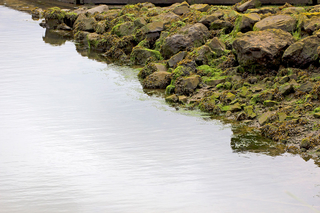
Placement of large stone, usually referred to as rip-rap, is the preferred and most common form of shore protection. At that place are technical methods available to make up one's mind rock size, placement geometry and elevations to ensure the all-time protection. Your county Soil and Water Conservation District (SWCD), the MN Board of Water and Soil Resources (BWSR) and the federal Natural Resources Conservation Service (NRCS) can provide technical assistance.
The above agencies will also have information on other types or remedies that may exist appropriate for your particular situation. Potential shore protection alternatives include:
- Bulkheads (retaining walls).
- Gabions (rock-filled wire baskets).
- Articulating blocks (cable-connected physical blocks).
- Geoweb matrix (thick, open-cell plastic grid).
A few of the alternatives tin be placed by hand. Another alternatives, such every bit railroad ties, are often tried only rarely work. If you take your own idea for a solution, you should seek technical advice first.
Rip-rap (big rocks)
Planting native aquatic vegetation volition unremarkably stabilize a shoreline if done properly. In the rare cases when that is not possible, rip-rap may be used equally a last resort. If rip-rap is used, crushed or blasted rocks lock together better than rounded boulders. Still, this method can be very expensive unless rip-rap is readily available.
Employ geotextile fabric
Geotextile textile is usually placed beneath the rock rip-rap to prevent soil loss through the rock openings. It's easy to identify and provides an excellent filter barrier.
- Prevent punctures: In lodge to prevent punctures, enough of slack should be provided over protruding objects that cannot be removed. A layer of sand or fine gravel can be placed on the fabric for extra protection confronting puncture.
- Wrap together as i unit: Enough textile should be laid out and then that the rip-rap periphery tin be "wrapped" by bringing the fabric upwards and back down into the rip-rap. This will help hold the rip-rap together as ane structural unit of measurement. Go along in mind that sunlight volition degrade exposed textile.
- Graded filter layer: As an alternative to the fabric, a graded filter layer can be used beneath rip-rap to prevent soil loss through the rip-rap openings.
Toe protection
Sufficient stone must be placed at the base of operations of the rip-rap for toe protection. Excavated toe material must be removed from the lakebed and placed in a not-wetland area.
Hiring help
Rip-rap installation
The cost of rip-rap placement depends on local contractors, distance to the nearest stone source and access to the projection site. Information technology also depends on how much other piece of work, such as clearing or earthwork, is required.
Protection for Lake Superior shoreline typically costs more than than for inland lake shoreline. Inquire at the canton SWCD part about cost-share assistance.
A project cost can likewise exist estimated by calling earthwork contractors in your surface area. A large savings can be realized if you can install these items yourself.
Stabilizing a slumping bluff
Find out about soil types and ground water level
If y'all desire to stabilize a slumping barefaced, discover out well-nigh soil types and ground h2o level. The record from when your well was drilled may be a good data source. Y'all can obtain this record from the state or county wellness department or from your well driller. Contact your county SWCD for information on soils.
Get technical assistance
Constructive bluff stabilization volition crave technical help.
You can:
- Request an engineer from the BWSR, SWCD or NRCS to audit your site.
- Consider hiring a geotechnical engineering science firm. They can take soil borings, analyze soil properties and recommend a remedy.
Regulations often employ
All erosion protection projects that alter the lakebed or riverbed require a protected waters permit from the Department of Natural Resources (DNR).
Contact the DNR Area Hydrologist for:
- Permit guidelines.
- Other agencies that might require a permit.
- For help in planning your erosion prevention project.
Some rip-rap projects may not demand a permit.
For more data
Local government offices:
- Soil and Water Conservation District (SWCD).
- Planning and zoning department.
- Watershed Districts.
Minnesota state agency regional offices:
- Minnesota Lath of Water and Soil Resource (BWSR).
- Minnesota Department of Natural Resources (DNR) Surface area Hydrologist.
Federal agencies:
- Natural Resource Conservation Service (NRCS).
- U.S. Regular army Corps of Engineers (USACE).
Reviewed in 2018
Source: https://extension.umn.edu/shoreland-properties/stabilizing-shoreline-prevent-erosion
0 Response to "Word for Stones Agains Shoreline to Prevent Erosion"
Post a Comment